Sensory Spaces Blog
By: Leanne Fleischmann
A Sensory Spaces playground = A Sensory Integration awakening!
You know, in many different instances we as humans ask about the bigger picture. We ask about how this will turn out in the end or what the outcome would be. What will it look like? How will it work? How good will the result be? The one thing we realised as these questions embarked on the journeys with us is, ‘It all depends on the soil’.
This might seem like a strange realisation but let’s look into it – I am not just talking about the literal sense of the word, but rather what this represents in our process and the process of each community that reaches high, bends low and touches their toes. The interpretation of what the soil represents is up to you. Each Sensory Space has its own story, its own victories.
The soil is a representation of growth, grounding and transformation; a foundation upon which growth can take place and upon which life can flourish. In order words, there is a village of people that are preparing a specific space, nourishing the soil and sustaining the force that allows their space and their children to transform. The heartwarming fact is that the transformation does not lie in the playground, but rather in the process of preparing the soil (no matter what this might represent for you).
In our most recent build with LINC Foundation in Kwazulu-Natal, we witnessed a village of people immerse themselves into the process without knowing what the bigger picture would really be. Looking back, the ‘soil’ represented a few things in their process.


For them, the success depended on:
- The hearts of the teachers towards the playground
- The conversations and connections amongst those building
- The transferring of skills to community members
- Serving the children
This is what the bigger picture depended on for this particular project and boy oh boy, the soil certainly delivered!
So what happens if I tell you that the success of your Sensory Spaces playground all depends on the soil? What does the soil represent in your space? Tell us your unique story.
For a particular individual, who assisted us in the LINC Foundation build, the bigger picture came through a personal awakening. We valued her presence, her input and her story that she was willing to share.
“Prior to meeting the SAISI and LINC Team to participate in a sensory playground build at Sogidi Primary in rural Kwazulu-Natal, I had very limited knowledge or awareness of sensory integration, sensory issues and the importance of sensory awareness. I had no idea of my own sensory issues and sensitivities, other than thinking I didn’t like getting dirty or being in loud spaces.
When I arrived on the first day of the build, I wanted to show my enthusiasm and willingness to participate, hoping this sentiment would override my dislike of dirt. We started the day stacking and slinging tyres, and within a few minutes, I could feel the familiar discomfort edging its way into my conscience. I was starting to get covered in tyre dust and muck, and my brain was having none of it.
In addition, there was a lot of clattering, banging, and digging going on. I started feeling acutely more uncomfortable and made an excuse to go and work in the library, as I had work to do online.
At the start of Day 2, I made a concerted effort to wear clothing that could get dirty, and started the day by digging, in dirt. I lasted for about an hour, and had to go inside again to calm my nerves. I didn’t think any of this had to do with sensory integration issues until I had a very honest conversation with Dr Annamarie van Jaarsveld and Leanne Fleischmann of SAISI, both highly qualified experts in the sensory integration field.
What I was experiencing was not just a case of being a diva or a drama queen and wanting to get away from getting dirty and doing hard work. These were signs of sensory processing sensitivities. Adults with sensory sensitivities can feel overwhelmed, anxious, and stressed in what I now know are called “sensory-rich environments”. I struggled to focus and actively engage because of everything that was going on during the build.
My emotional reactions were also interesting to witness. I felt embarrassed about being “useless” at the build, instead of acknowledging that it was a sensory overload, and it was fine to step out and come back in when I needed to. I felt frustrated and overwhelmed, as I often do at home when it comes to practical things. I felt like I was unable to engage with the people there, as I felt separate from them in terms of their abilities and my abilities. My immediate reaction at the playground build was to withdraw, and my reaction in my normal life was to withdraw as well.
But this is normal behaviour for anyone with sensory issues. The key lesson for me was to learn how to modulate (another word I learned) or regulate myself when I’m in that kind of situation. To give myself breathing room to be who I am and to learn how to adapt to all kinds of situations, without reactive anxiety.
I am immensely grateful to the SAISI team for the work they do for children in under-resourced areas, and I am grateful to the team for teaching me about my sensory issues, something I never thought about before I met them.”
There is so much food for thought as we reach high, bend low and touch our toes in this wonderful process of establishing Sensory Spaces across South Africa.
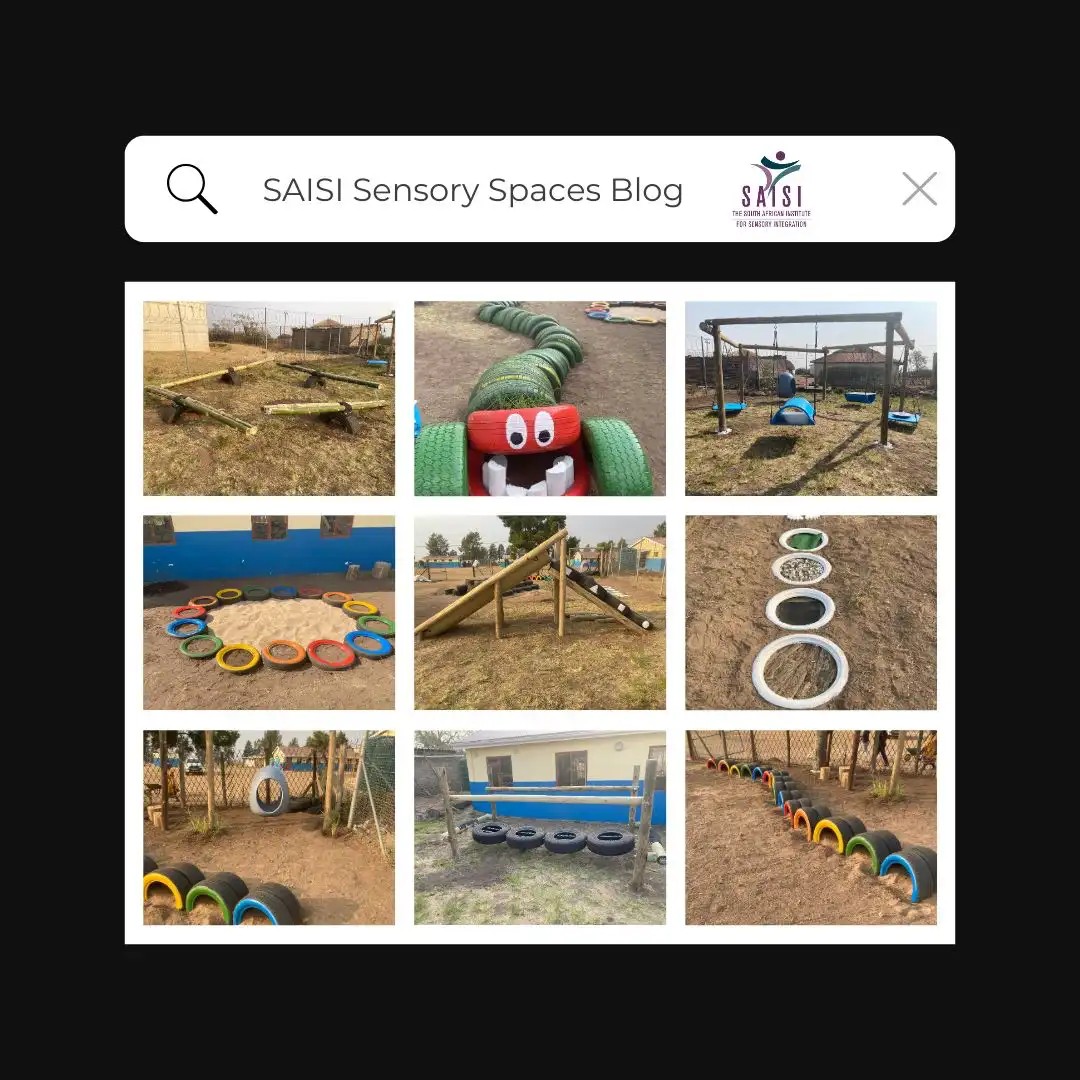
We have witnessed the process of ‘WAIT. WATCH. WONDER.’ as the monsters and shongololos take their place in the dirt and the Jojo slide reaches for hope in the sky.
The community members shared how amazing it was to think that they planted trees that their children will be sitting under in years to come, them spending time decorating their own homes after the building week (inspired by the tyre mountain that they built), to kitchen staff mentioning how they couldn’t believe how grateful everyone was for their cooking. Every person involved contributed towards the Sensory Spaces playground in some special way.


For me, standing in the space that transformed from an open, untouched, field to a fully equipped playground is an experience that I wish for every under-resourced community in South Africa. A space where silence and solitude is transformed to that of laughter, joy and dirty feet.
Each Sensory Space playground has its own story and as you can see, there are many special stories to share. We look forward to many more community stories of how our children have gained access to sensory-enriched opportunities through play and capturing the victories in our goal for sensory integration to touch lives across the lifespan.
What soil are you preparing?
What is your story?
We are gaining momentum in gathering the stories as we prepare to establish more Sensory Spaces playgrounds in the near future. Don’t wait to connect with us! If you are ready for your Sensory Integration Awakening, email us at sisensoryspaces@instsi.co.za.