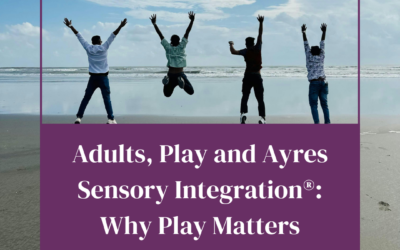
The theme of the next SAISI newsletter is ‘Play: The Heartbeat of Sensory Integration.’
I paused and wondered about play….Why is play so central to sensory integration? Why does something that looks so simple hold such neurological power? And what do we say when someone observes a therapy session and comments, “But it just looks like they’re playing?”
To explore these questions, who better to turn to than Dr A. Jean Ayres? In Sensory Integration and the Child, she reminds us that play is not incidental to development, it is foundational.
Play is Organising and Nourishing for the Brain
“A human being is designed to enjoy things that promote the development of his brain, and therefore we naturally seek sensations that help organise our brain… They want to move because the sensations of movement nourish their brains.” (Ayres, 2005, p.8)
Children are not moving randomly. They are moving with purpose, even if that purpose is not consciously directed. When a child spins on a swing, crashes into pillows, runs down a sand dune or begs to be picked up and rocked, their nervous system is actively seeking vestibular, proprioceptive and tactile input. We know that these sensations organise the brain.
Movement builds postural control. Heavy work refines body awareness. Touch supports security and regulation. Through play, neural pathways are strengthened, connections are refined, and the brain becomes more efficient.
Play is not a break from development, it is development happening in its most natural form.
Time Invested in Play Builds Sensorimotor Intelligence
“Seven or eight years of moving and play are required to give the child a sensorimotor intelligence that can serve as the foundation for intellectual, social and personal development.” (Ayres, 2005, p.25)
In a world increasingly focused on early academic achievement, Ayres offers a powerful reminder: the foundation for higher-level skills is built through years of movement and sensory experience. Sensorimotor intelligence precedes academic intelligence.
Before a child can sit still and concentrate, their body must feel stable and safe. Before handwriting can become automatic, postural control and bilateral integration must be established. Before complex problem-solving, the nervous system must support regulation.
Play lays this groundwork. When we rush children into formal learning without adequate sensory foundations, we risk building on unstable ground.
Protecting time for play is not indulgent or irresponsible, it is neurologically enriching.
Play is Learning How to Learn
“It may look as though the child at play is not learning anything, but actually he is learning something very basic; he is learning how to learn.” (Ayres, 2005, p.54)
In play, children experiment. They test gravity. They plan movements. They adjust when something doesn’t work. They negotiate with peers. They build frustration tolerance. They persist.
They are developing praxis, problem-solving, emotional regulation, sequencing, and flexibility, all of which are essential for academic and life success. Play develops the capacity for a child to respond to a challenge in a meaningful and successful way. Through play, the nervous system becomes more efficient at processing information and generating organised responses. The child is not just acquiring skills; they are developing the neurological capacity to acquire skills.
They are learning how to learn.
When It “Just Looks Like Play,” We Know Integration Is Happening
“When the therapist is doing her job effectively and the child is organising his nervous system, it looks as if the child is merely playing. Life is full of paradoxes; this is one of them.” (Ayres, 2005, p.142)
To an observer, a session may appear simple: swinging, climbing, crashing, laughing. But beneath the surface, the therapist is carefully grading challenges, observing, facilitating, supporting regulation and eliciting adaptive responses.
The activity is playful, but it is never random.
When therapy is effective, it does not feel like hard work. The child is motivated, engaged, and intrinsically driven. The nervous system is doing the work it is designed to do.
The Just-Right Challenge Feels Like Fun
“When the child experiences challenges to which he can respond effectively, he ‘has fun’. To some extent, ‘fun’ is the child’s word for sensory integration.” (Ayres, 2005, p.8)
The task must be difficult enough to require effort, but achievable enough to allow success, the just-right challenge. Fun is not the opposite of effort. Fun is the nervous system signalling engagement at exactly the right level. It reflects optimal arousal, motivation and attention. Laughter and hard work coexist. Joy and neural organisation happen simultaneously.
As occupational therapists, educators, parents and play partners, Ayres’ words call us to advocate for play with renewed confidence. When we protect play, we protect development. When we encourage and give the space and time for children to move, explore, crash, climb and create, we are not distracting them from learning, we are building the very foundation that learning rests upon. Play is not an extra. It is not a reward. It is not wasted time.
Play is the heartbeat of sensory integration. Play is essential.
Reference
Ayres, A. J. (2005). Sensory Integration and the Child: Understanding hidden sensory challenges (25th anniversary ed.). Western Psychological Services