+2776 329 9403
saisi@instsi.co.za
SAISI Member Area
My Cart
My Account

Ethics and social media

by | Sep 15, 2021

Today Jaimie Andrews shares the last blog post in our series on ethics, this time tackling the very current concerns of confidentiality and consent on Facebook, Twitter and Instagram.  Happy reading!

Ethical guidelines on social media: Guidelines related to confidentiality and consent.

Full disclaimer (as is my ethical responsibility, of course): while I do use the WhatsApp to send text messages, images, photographs, Word documents, PDFs and even voice-notes to my clients and colleagues, I know less about Facebook walls than the one Humpty Dumpty fell off, less about Twitter handles than I do about door-handles (which isn’t much in the first place), less about Insta-posting than the fine-motor activity of coin-posting and more about how to tell time than how to TikTok…

I am not typical of my generation of early 30-year-olds at all! Never having owned a Kindle, iPad, tablet or FitBit, even pre-schoolers are schooling me every day on the latest communication technology. That now being out in the open, let’s all learn together about social media in and outside of our workplace – be it at a hospital, government institution, private practice, school, community clinic, or NGO, etc. Social media is without such geographical boundaries. That is what makes it so incredible and simultaneously so dangerous. As it is often quoted: “With great privilege comes great responsibility” (debatable source).

Social media is making such fortunate freedom of communication more and more accessible to the general public. This means that those in positions of power, authority and influence(r) all need to take more and more responsibilty for their social media presence, representation, endorsements, affiliations, etc and be accountable for it too.

Social media is defined in the HPCSA Ethical Guidelines’ Booklet 16 as “the online tools and electronic platforms that people use to share content such as opinions, information, photos, videos and audio…social networks, content-sharing platforms, personal and professional blogs, internet discussion forums… comment sections or websites.” (page 6, Pretoria, September 2016).

Booklet 16 then goes on to list the pros (+) and cons (-) of using social media for health professionals:


PRO’s: CON’s:

(+) staying updated with the most recent research and advancements in healthcare via legitimate online sources(+) developing supportive community with colleagues

 (+) educating both the public and health profession by spreading relevant content fast; far and wide


(-) blurring boundaries with TeleHealth/ Tele-Medicine

(-) complicating storage of client’s (digital) data

(-) risking accidental breech of client’s confidentiality

(-) possibly appearing as though unfairly advertising and/ or touting for services


Unsurprisingly, Booklet 16 emphatically reminds us to double-, triple- and quadruple-check exactly what information our clients/ parent(s) of minor (underage) clients have and have not consented to us sharing with others – be they fellow health professionals treating the same client or distant relatives seen once annually. This needs to be specified in no uncertain terms in our contracts with our clients. Seeking professional legal advice, especially now in the time of POPIA, is recommended to ensure all our professional communications are fully covered.

When it comes to posting something – anything! – on any social media platform (including WhatsApp, YouTube, Twitch, etc.), there are a few very important and specific questions we must ask ourselves before doing so. They are similar to the social rule: THINK before saying or doing anything – is what I’m about to say or do True, Helpful, Interesting, Nice and Kind?

We must, therefore, ask ourselves – before posting, forwarding, sharing, retweeting, commenting, liking, hash-tagging or even taking a screenshot – which details of our clients do we have and not have C-O-N-S-E-N-T to share. We need to ensure that we have not unintentionally shared sufficient detail for the reader/ viewer of our social media post to guess the identity of our clients without us naming them.

As a result, we need written consent from the client/ parent(s) thereof for us to share any but especially specific details of her/his case before doing so. This means that it must be made explicitly clear what information will be shared and, therefore, what information will remain confidential, the format in which it will be shared and, of course, the social media platform(s) on which it will be shared by the health professional.

The above stands regardless of the clients age and even post-discharge from our treatment services. This means that, even after terminating the professional relationship with the client, we may not ever share anything of hers/ his without prior written consent, even after death. I would imagine the next of kin would have to be approached for consent should it be deemed worthy.

If nothing else, we must think of our reputations – not just as professional individuals, but as representatives of our Occupational Therapy profession, as well as larger community of Allied Rehabilitation and Health Professionals. Furthermore, we must continue to consider not just our professional selves, but our personal profiles on social media platforms. Our clients and colleagues will most certainly be looking up our names and histories via all online search engines, when referred on to us.

Remember, like most interactions (whether in-person or online), social media platforms are a two-way street: as much as you’re looking up, at, through another person’s profile, others are doing the same to yours.

Blog Author

Recent posts

Browse the past Blog posts

Related blogs

Autism in Focus 2026: Looking Beyond What We See

Different perspectives, fresh insights and a reminder that there’s always more to learn.
What does it really mean to understand an autistic child? Is it about recognising certain behaviours, knowing the diagnostic criteria, or finding the right therapeutic approach? Or is it about something much bigger?

On 16 and 17 October 2026, the South African Institute for Sensory Integration (SAISI) hosted Autism in Focus 2026, a two-day online event bringing together therapists, healthcare professionals, parents and teachers to explore autism from different perspectives.

And what a variety of perspectives there were! From sensory integration, communication and DIRFloortime® to anxiety, demand avoidance, feeding, medical research and self-advocacy, there was plenty to think about.

But perhaps one of the most valuable messages was surprisingly simple: sometimes we need to stop focusing on what a child is doing and start wondering why.

There’s Always More Behind the Behaviour

We’ve all encountered a child who refuses an activity, struggles with transitions or becomes overwhelmed by something that seems relatively small. Our first instinct might be to ask, “How do we get this child to cooperate?”

But what if we asked a different question? What if we asked, “What is this child trying to tell us?”
Emma Wijnberg explored autism through a sensory integration lens, while Elize Janse van Rensburg’s presentation on anxiety, autonomy and demand avoidance encouraged consideration of the demands children face.

A child who refuses an activity might be anxious. A child who runs away might be overwhelmed by sensory input. A child who repeatedly asks the same question might simply be looking for reassurance.

The behaviour is what we see. Understanding what lies beneath it is where meaningful support begins.

One of the most powerful concepts highlighted in the event’s educational material was the invisible load autistic children may carry throughout their day. Imagine a child arriving at school with an empty backpack. Throughout the day, we add a book for every demand: classroom noise, social expectations, following instructions, managing transitions, concentrating and coping with unexpected changes.

By home time, that schoolbag is pretty heavy!

Yet, from the outside, the child may appear to have had a perfectly good day. Some children with Autism also mask their difficulties, working incredibly hard to fit in, follow expectations and appear as though they are coping.

And then they get home.

The tears start. The frustration spills over. Perhaps there’s a meltdown over something seemingly insignificant. But was it really about that small thing? Or was it the weight of everything that came before it? It leaves us with a question worth remembering:

Instead of asking, “Can this child cope?”, perhaps we should ask, “What is it costing them to cope?”

Different Approaches, One Child

What made Autism in Focus particularly interesting was the variety of professional perspectives.

Jessie-Anne Bird explored the identification of autism and SPELL principles, while Belinda von Wielligh introduced the relationship-based DIRFloortime® approach, reminding us of the importance of connection and meaningful play. Dr Gina Rencken provided a perinatal perspective on autism and early neurodevelopment.

Rochelle Thanjan highlighted neurodiversity-affirming communication, while
Kath Megaw explored feeding differences, sensory regulation and gut–brain links.
The programme also ventured into medical territory, with Dr Nerica Ramsundhar discussing emerging research involving leucovorin, and Prof Wattie Janse van Rensburg addressing the ethics of genetic testing.

Dr Andy Hoffmeyer discussed medication as a possible support for neurodivergent children, while Jessica Jansen van Rensburg considered low-demand parenting and the use of visual schedules.

Another important contribution came from Dr Emile Gouws, who brought the conversation back to autistic voices, self-advocacy and the broader neurodiverse community. He shared his own experiences as a young non-verbal child who was later diagnosed on the autism spectrum.

There were so many different perspectives, yet all encouraging us to see the child as more than a diagnosis or a collection of challenges, because there is no single approach that fits every autistic child. Understanding the individual will always matter.

Not every professional development event needs to introduce something completely new. Sometimes, hearing a familiar idea explained differently is enough to make us reconsider how we approach our work. This was beautifully captured by therapist Serna Smit, who shared:

“Autism in Focus was a valuable and inspiring event. Although not all the information was new, it encouraged me to reflect on my therapeutic approach and reignited my passion for learning. The discussions on PDA, diagnosis and Floortime were particularly insightful.
The online format was convenient, the cost affordable, and the CPD points an added bonus! Access to the presentation slides afterwards would have been appreciated.
Overall, a wonderful reminder that even experienced therapists always have something new to learn!”

And isn’t that exactly what professional development should do?

The convenient online format, affordable cost and CPD accreditation made the event accessible, while the opportunity to revisit familiar concepts through different lenses added real value.

Taking It Back to the Children

At the end of the day, the value of an event like Autism in Focus lies in what we take back into our therapy rooms, classrooms and homes. Perhaps it’s being a little more curious before responding to a child’s behaviour. Perhaps it’s recognising that the child who looks perfectly fine at school might be working harder than we realise. Or perhaps it’s remembering that connection, predictability, autonomy and feeling understood can be just as important as the skills we’re trying to teach.

Our goal shouldn’t simply be children who look as though they’re coping. It should be children who genuinely feel safe, supported and understood.

Autism in Focus 2026 was a valuable opportunity to reflect, reconsider and keep learning. Because whether we’ve been practising for two years or twenty, there is always something more to discover about the children we support.

And sometimes, a small change in how we look at a child can make a big difference in how we support them.

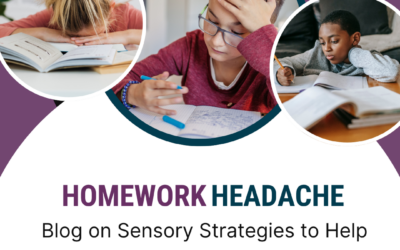
Homework Headache: 

Homework Headache: 

Sensory Strategies to Help  Homework time can be difficult for many families. Your child may leave the table constantly, rock on his or her...